Most people search for a paper trading platform because they want to test a strategy without risking capital. That is a perfectly reasonable thing to want.
But if you are building systematic strategies, there is a second problem that matters almost as much as the first:
If the paper trade works, can you prove it later?
That is where ordinary paper trading starts to break down. A simulated account can help you debug orders, learn a platform, and see whether a strategy behaves as expected. But if the strategy performs well for six months, the result often still looks like a claim. A spreadsheet. A screenshot. A broker demo account. Something that may be true, but is hard for someone else to independently trust.
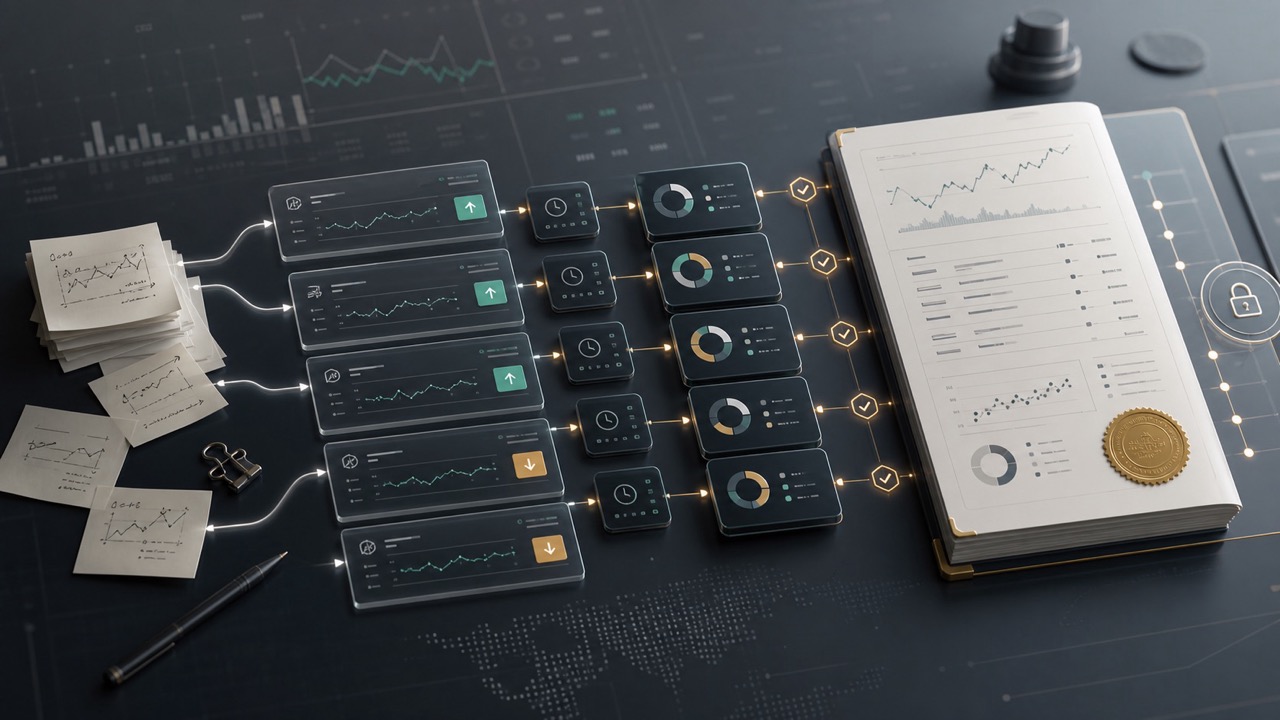
TradeLock is built for a slightly different version of paper trading: forward-recording strategy intent so the experiment can become a record.
You still avoid putting capital at risk. You still test the strategy live, against current markets. But if it does well, you have something more useful than "I paper traded this." You have a timestamped forward record that can be inspected later.
What paper trading platforms usually solve
Paper trading is not new. There are plenty of tools that let you simulate orders:
| Platform | What it is good for | Where it usually stops |
|---|---|---|
| TradingView Paper Trading | Chart-based practice, discretionary testing, Pine Script ideas, alerts, and market visualization | Great for simulation and workflow, but not designed primarily as an independent proof layer |
| Alpaca Paper Trading | API-based algo testing for developers | Strong developer workflow, but the paper record lives inside the broker/API environment |
| Tradier Sandbox | API development, broker-connected testing, stocks, ETFs, and options workflows | Useful sandbox, but tied to Tradier account/API setup |
| Interactive Brokers free trial and paper trading | Testing a serious brokerage platform, order types, and APIs | Powerful but heavier than needed for simple strategy incubation |
| thinkorswim paperMoney / Webull paper trading | Retail practice, options education, and learning order mechanics | Useful for practice, less natural as a systematic multi-strategy proof record |
Those platforms are useful. Alpaca and Tradier are especially natural if you want an API-based paper trading environment. Interactive Brokers and thinkorswim are strong if you care about broker platform behavior. TradingView is excellent if the strategy starts from charts, Pine Script, or alerts.
They also support things TradeLock does not fully support yet. Options and futures are the obvious examples. Many broker paper trading platforms already have mature options workflows, and some support futures or futures-like simulation. TradeLock is focused today on liquid, lower-frequency strategies in stocks, ETFs, crypto-like symbols, and model portfolios. Options and futures are on the roadmap, but if your immediate need is to simulate a complex options spread or futures execution workflow, a broker paper account may be the better first tool.
But that is the point: these tools mostly answer "Can I simulate trading?"
TradeLock is trying to answer a different question: "Can this paper trading experiment become evidence?"
The missing feature is proof
The weakness of most paper trading is not that it is fake. Of course it is fake. That is the point.
The weakness is that the record is easy to dismiss after the fact.
If you show someone a backtest, they wonder how many versions you tried before showing this one. If you show them a spreadsheet, they wonder whether the losing trades were edited out. If you show them a demo account screenshot, they wonder whether the strategy was actually running before the move happened.
That skepticism is not cynicism. It is just experience.
A strategy record becomes more credible when the signals were recorded before the outcome was known. That is the gap TradeLock is meant to fill.
How TradeLock works as a paper trading platform
TradeLock is not a broker. It does not route orders to an exchange, hold your assets, or replace your live brokerage account.
It records trading intent.
A typical workflow looks like this:
- Your strategy decides what it wants to own.
- You submit that signal to TradeLock manually, by API, or through an integration.
- TradeLock records the signal with a server-side timestamp and market price context.
- The strategy builds a forward record over time.
- If the record becomes interesting, you can show a public factsheet instead of asking people to trust a backtest.
For a systematic trader, that matters because the experiment is no longer disposable. A strategy that looks bad can be archived. A strategy that looks good can become a track record.
Built for systematic, mid- to long-term strategies
TradeLock is a better fit for some strategies than others.
It works best for liquid, rule-based strategies where the signal matters more than microsecond execution:
- ETF rotation models
- Tactical asset allocation
- Weekly or monthly momentum systems
- Trend-following model portfolios
- Sector rotation
- Quant equity baskets
- Medium-term crypto allocation models
- Strategies that rebalance by target weights
These are exactly the strategies many systematic traders have sitting around in notebooks, scripts, or research folders. You may have ten ideas that look promising in a backtest, but only enough capital or operational focus to trade two of them live.
With TradeLock, the other eight do not have to disappear. They can run forward as paper strategies. Six months later, you know which ones survived contact with the real market.
That is more useful than another optimized backtest.
API paper trading without opening another brokerage account
Alpaca and Tradier are good choices when you want API-based paper trading inside a brokerage-style environment. The tradeoff is that you generally need to create and configure an account in that ecosystem.
TradeLock is lighter. If your strategy already produces signals, you can send them to TradeLock instead of wiring the strategy into a broker first.
The Manager API supports API-key authentication, sandbox-scoped keys, idempotency keys, canonical target portfolios, quantity orders, percent-of-NAV orders, and queued processing when markets are closed. In practice, every new integration publishes the same versioned envelope:
{
  "protocol_version": "1.0",
  "strategy_id": "Momentum Core",
  "idempotency_key": "momentum-core-aapl-2026-06-16",
  "payload": {
    "type": "percent_order",
    "symbol": "AAPL",
    "side": "buy",
    "percent_of_nav": 10
  }
}
Or it can submit a full target portfolio:
{
  "protocol_version": "1.0",
  "strategy_id": "ETF Rotation",
  "idempotency_key": "etf-rotation-2026-06",
  "payload": {
    "type": "target_portfolio",
    "scope": "full",
    "targets": [
      { "symbol": "SPY", "weight_pct": 40 },
      { "symbol": "TLT", "weight_pct": 30 },
      { "symbol": "GLD", "weight_pct": 20 },
      { "symbol": "BIL", "weight_pct": 10 }
    ]
  }
}
That is the basic idea: your model emits the same kind of target it would eventually send to a broker, but for now it goes to TradeLock and becomes part of a forward record.
For implementation details, see the TradeLock Getting Started guide and the Manager API Reference.
TradingView, Pine Script, and alerts
Many systematic traders do not start from a Python server. They start in TradingView.
That is fine. TradingView can send webhook alerts when an alert is triggered, and if the alert message is valid JSON, TradingView sends it as JSON. That means a Pine Script strategy or indicator can generate an alert payload, and that payload can be routed to TradeLock.
For security, the recommended path is not to casually paste secrets into public scripts or screenshots. TradeLock's public quickstart describes a TradingView path through a Cloudflare relay, where TradingView sends JSON to the relay and the relay forwards the payload to TradeLock.
This makes TradeLock useful even if your research workflow is:
- Write or adapt a Pine Script rule.
- Create a TradingView alert.
- Send the alert payload through the TradeLock relay.
- Let the strategy build a forward-recorded paper track record.
That is a much better outcome than letting a good TradingView idea live only as a chart annotation or private alert history.
Why this is different from a normal simulator
A normal paper trading platform helps you practice.
TradeLock helps you practice in a way that may leave behind proof.
Regular paper trading is useful for:
- Learning order mechanics
- Testing a user interface
- Debugging a trading bot
- Seeing whether a strategy behaves sensibly
- Avoiding capital risk while you experiment
Verifiable paper trading adds another layer:
- The signal is recorded forward in time.
- The record can be inspected later.
- The strategy can have a public factsheet.
- The experiment can become a due-diligence artifact.
- A good result does not have to vanish into "trust me."
This does not make paper trading the same as live trading. It does not prove that every fill would have happened at the exact recorded price. It does not capture all slippage, market impact, borrow constraints, option assignment behavior, futures margin details, or the emotional reality of risking real money.
But for lower-frequency systematic strategies, it can answer a valuable question:
Did this strategy send these signals before the market outcome was known?
That is a much stronger question than "Can you show me a backtest?"
A practical example
Imagine you have a monthly ETF rotation strategy.
At the end of each month, the model ranks a universe of ETFs by trend, volatility, and drawdown. It selects four ETFs and assigns target weights. You are not ready to trade it live. Maybe you already have capital in other strategies. Maybe you do not fully trust the model yet. Maybe you want to see how it behaves through a few market regimes.
The normal path is to paper trade it somewhere, or log it in a spreadsheet.
The TradeLock path is different:
- Create a strategy called "ETF Rotation - Forward Test."
- Give it an initial notional capital value.
- Submit the monthly target portfolio through the API.
- Let TradeLock record each rebalance.
- Review the public or private factsheet after 3, 6, or 12 months.
If the strategy fails, fine. That is what experiments are for.
If it works, you now have a forward record. You can take that record to a potential investor, a signal marketplace, a newsletter audience, or your own decision process. You are no longer saying, "The backtest looked good." You are saying, "This strategy has been running forward since this date. Here is the record."
That is the difference.
What TradeLock is not good at
It is worth being direct.
TradeLock is not built for high-frequency trading. It is not the right proof mechanism for intraday scalping, latency-sensitive execution, thinly traded instruments, or strategies where queue position is the edge.
It is also not yet the best tool for complex options or futures strategies. Other paper trading platforms are ahead there today. If you need to test multi-leg options execution, futures margin behavior, assignment, expiry, or highly specific broker mechanics, use a broker simulator built for that.
TradeLock is for the strategy layer: the decision, the allocation, the signal, the rebalance, the forward record.
That makes it especially relevant before you go live, before you open another broker account, or before you pay to list a strategy somewhere else.
Paper trading vs. verifiable paper trading
Here is the simplest way to think about it:
| Question | Normal paper trading | TradeLock |
|---|---|---|
| Can I test without risking money? | Yes | Yes |
| Can I connect a systematic workflow? | Often, depending on platform | Yes, through API or integrations |
| Can I use TradingView alerts? | TradingView can simulate and alert | TradingView alerts can be routed into TradeLock |
| Do I need a broker account? | Often yes for broker simulators | No, TradeLock is not a broker |
| Can I prove the strategy was running forward? | Usually difficult | That is the point |
| Is it a substitute for audited live brokerage records? | No | No |
| Is it useful before going live? | Yes | Yes, especially if you want proof later |
The distinction matters because many systematic traders are not just trying to learn how to click buy and sell. They are trying to decide which strategies deserve capital.
That is a different job.
FAQ
What is a paper trading platform?
A paper trading platform lets you simulate trades without risking real money. Some platforms focus on manual practice, while others support API-based trading bots and systematic strategies.
Can I paper trade with an API?
Yes. Alpaca, Tradier, Interactive Brokers, and other broker-connected platforms support API-based testing in different ways. TradeLock also supports API-based paper strategy tracking, but it is not a broker. It records strategy intent and builds a forward record.
Is TradeLock a broker?
No. TradeLock does not execute live orders or hold customer assets. It records strategy signals and creates a forward-tracked record.
Is TradeLock an alternative to Alpaca or Tradier paper trading?
Sometimes, but not always. If you need broker-like simulated execution, Alpaca or Tradier may be the right tool. If you want to record a strategy's forward signals so the paper trading experiment can later be inspected, TradeLock solves a different problem.
Can I use TradeLock from TradingView?
Yes. A Pine Script strategy or indicator can trigger TradingView alerts, and TradingView webhook alerts can send JSON to an external endpoint. TradeLock documents a TradingView relay workflow in the Getting Started guide.
Does verifiable paper trading prove a strategy will work live?
No. Paper trading is still paper trading. It does not fully capture slippage, market impact, fees, liquidity, taxes, borrow costs, or trader behavior under real risk. It can, however, help prove that the strategy signals were recorded before the outcome was known.
What strategies fit TradeLock best?
TradeLock is best suited for systematic, liquid, lower-frequency strategies: weekly or monthly rebalances, ETF portfolios, tactical allocation, trend models, and medium-term stock or crypto allocation systems.
Can a paper trading experiment become a track record?
That is the goal. Not every experiment deserves to be shown. But if a strategy runs forward for months and performs well, a TradeLock record gives you something more credible than a backtest or screenshot.
Start with the experiment
If you are looking for a paper trading platform, start with the real question.
Do you only want to practice? Then a broker simulator or TradingView Paper Trading may be enough.
Do you want to test a systematic strategy and maybe prove later that it was running before the results were known? That is where TradeLock fits.
The downside of a failed experiment is small. The upside of a successful one is that it does not have to remain a private story. It can become a record.
Create a free TradeLock account and start forward-tracking your first strategy.
TradeLock records trade intent at public market prices with server-side timestamps. It does not execute trades, provide investment advice, or replace live brokerage records. Paper trading results are simulated and may differ from live trading results.